
How Poor Accounting Entries Create Expensive Reconciliation Problems

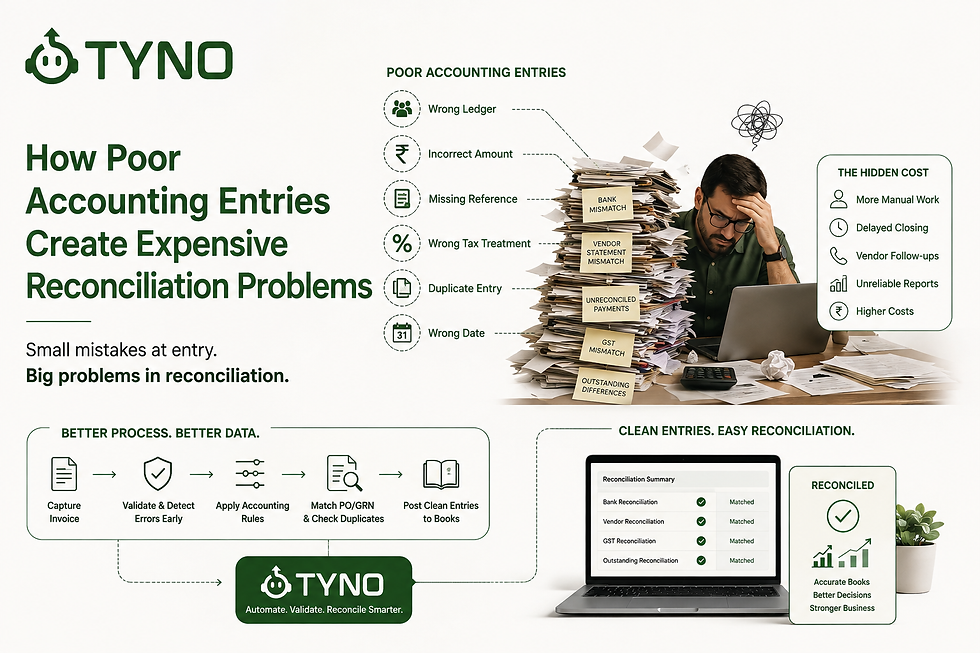
Reconciliation is often treated as a routine accounting activity: compare two sets of records, identify differences, investigate them, and make corrections.
But in many businesses, reconciliation takes far longer than it should. The problem isn't always the reconciliation process itself.
The real problem often starts much earlier—with poor accounting entries.
A wrong ledger, incorrect amount, missing invoice reference, duplicate entry, or incorrect tax treatment can create discrepancies that finance teams may spend hours or even days trying to resolve.
As transaction volumes increase, these small errors can become expensive operational problems.
What Makes an Accounting Entry Poor?
A good accounting entry should accurately represent the underlying business transaction and contain enough information to identify and verify it later.
Poor accounting entries can happen in several ways:
An invoice is posted to the wrong ledger.
The amount entered doesn't match the source invoice.
GST or other tax components are recorded incorrectly.
The invoice number or reference is missing.
The transaction date is incorrect.
The same invoice is entered more than once.
A payment is mapped to the wrong vendor or customer.
Similar vendors are recorded under inconsistent names.
Purchase invoices are posted without considering the corresponding PO or GRN.
Individually, these may look like small mistakes. The problem is what happens afterward.
One Incorrect Entry Can Create Multiple Reconciliation Problems
Consider a simple example.
A business receives a purchase invoice for ₹85,000 from a supplier. The invoice is accidentally recorded under the wrong vendor ledger. Later, the business makes the payment correctly to the supplier. The bank statement shows the payment. But when the finance team reconciles the supplier account, the payment doesn't appear to settle the expected invoice.
Now someone has to investigate:
Was the payment made?
Which invoice was it for?
Which vendor ledger was used?
Was the invoice posted correctly?
Was the payment allocated correctly?
Does the supplier's statement match the company's books?
What started as one incorrect accounting entry has now created a reconciliation exercise.
And this happens across thousands of transactions in larger businesses.
Reconciliation Problems Don't Always Originate in Reconciliation
This is an important distinction.
When finance teams find a mismatch, the immediate reaction is often:
"We need to reconcile this."
But the better question is:
"Why did this mismatch occur in the first place?"
If the underlying accounting data is unreliable, improving the reconciliation process alone won't solve the problem.
Finance teams will simply become better at identifying and fixing errors that shouldn't have occurred.
This creates a cycle:
Transaction → Incorrect Entry → Mismatch → Investigation → Correction → Reconciliation
The objective should be to prevent as many unnecessary mismatches as possible before they reach the reconciliation stage.
The Hidden Cost of Poor Accounting Entries
The cost of accounting errors is not limited to the correction itself.
1. Finance team time
Someone has to identify the discrepancy, find the source document, check the accounting entry, communicate with other teams, and make the correction.
Multiply that by hundreds of exceptions and the hours add up quickly.
2. Delayed month-end closing
Reconciliation is often one of the final steps before financial reports are finalized.
If there are too many unresolved differences, the month-end close gets delayed.
3. Vendor and customer follow-ups
Incorrect entries can result in statements that don't match.
This can lead to unnecessary emails and calls between the finance team and vendors or customers.
4. Unreliable reporting
Poor accounting data doesn't only affect reconciliation.
It can also affect:
Outstanding reports
Expense analysis
Cash-flow visibility
Payables
Receivables
Profitability analysis
Management reporting
If the underlying entries are wrong, the reports built on top of them cannot be completely reliable.
5. Higher operational costs
As transaction volumes grow, businesses may respond to increasing accounting workload by adding more people.
But if the underlying process continues producing errors, additional employees may simply spend more time correcting the same problems.
Why the Problem Gets Worse as Invoice Volume Increases
Suppose a business processes 50 purchase invoices a month. Even if a few entries require manual correction, the workload may remain manageable.
Now imagine the same business processes 2,000 or 5,000 invoices every month. Even a small percentage of errors can create a significant number of exceptions.
For example, if just 2% of 5,000 invoices require investigation, that's 100 transactions requiring additional attention.
The challenge isn't necessarily that the accounting team is inefficient.
The process itself may be creating too many exceptions.
The Role of Standardized Accounting Rules
One way to reduce these problems is to standardize how transactions are recorded.
For example, businesses can define rules around:
Vendor and customer mapping
Expense classification
GST treatment
Purchase categories
Cost centers
Payment allocation
Invoice references
PO and GRN matching
Instead of relying entirely on individual judgment for every transaction, repeatable accounting decisions can be turned into consistent rules.
This creates more predictable accounting data.
Validation Before Posting Is Better Than Correction Later
A useful principle for finance automation is:
Prevent errors before they enter the books whenever possible.
Before an invoice is posted, businesses can validate important information such as:
Is the invoice a duplicate?
Does the vendor already exist?
Does the invoice amount match the source document?
Is the tax calculation correct?
Is there a corresponding PO or GRN?
Is the invoice being mapped to the appropriate ledger?
Are required fields missing?
The earlier an error is detected, the cheaper it generally is to correct.
Automation Should Reduce Exceptions, Not Just Data Entry
When businesses think about accounting automation, the focus is often on saving data-entry time. That's useful, but it is only part of the opportunity.
A better automation workflow should help create clean accounting data.
For example, an automated invoice-processing workflow can extract information from invoices, identify duplicates, suggest appropriate ledgers, apply accounting rules, and match invoices against purchasing records before the transaction reaches the accounting system.
Tools such as Tyno are designed around this broader approach—helping businesses automate finance workflows while maintaining structured accounting data and integrating with systems such as Tally.
The goal isn't simply:
"Enter invoices faster."
It is:
"Create fewer accounting problems downstream."
Better Reconciliation Starts Earlier in the Process
Reconciliation will always remain an important part of accounting. But businesses shouldn't look at reconciliation as an isolated activity.
The quality of reconciliation depends heavily on the quality of the transactions being reconciled.
A useful way to think about the process is:
Better Source Data → Better Accounting Entries → Fewer Exceptions → Easier Reconciliation → Faster Closing
Instead of continuously increasing the effort spent fixing accounting errors, businesses can focus on reducing the number of errors entering the system in the first place.
Final Thoughts
Poor accounting entries may look like small operational mistakes. But when transaction volumes increase, they can create a chain of expensive consequences—from reconciliation work and vendor follow-ups to delayed closing and unreliable financial reports.
The answer isn't necessarily to make the finance team work harder. It is to improve the process that creates the accounting data.
Because the cheapest reconciliation problem is the one that never gets created.


Comments