
Why Invoice OCR Alone Doesn't Solve Finance Operations
- vikas hiran
- 1 day ago
- 4 min read

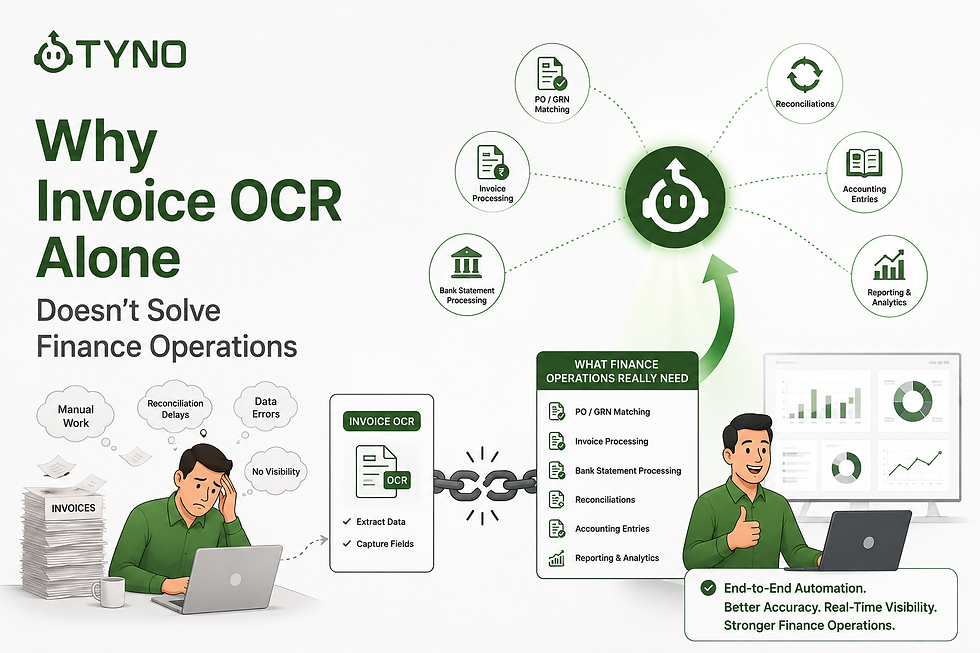
If you search for ways to automate invoice processing, you'll quickly find dozens of Invoice OCR solutions.
Most promise the same thing:
"Upload your invoice, and we'll extract all the data automatically."
At first glance, it sounds like the perfect solution.
No more manual typing.
No more copying invoice numbers.
No more entering GST details.
Problem solved. Or is it?
For many finance teams, the real work actually begins after OCR finishes.
The biggest bottlenecks in finance operations aren't caused by reading invoices—they're caused by everything that happens next.
Let's explore why.
What Invoice OCR Actually Does?
Invoice OCR (Optical Character Recognition) converts information from invoices into structured data.
A good OCR engine can identify:
Vendor name
Invoice number
Invoice date
GSTIN
Invoice value
Tax amounts
Line items
This saves time compared to manual data entry.
But extracting data is only the first step of the accounting process. Imagine receiving a package. OCR tells you what's inside the box. Finance still has to decide what to do with it.
The Real Finance Workflow Starts After OCR
Let's follow the journey of a purchase invoice.
Traditional Workflow
Invoice Received
↓
OCR Extracts Data
↓
Finance Reviews Extracted Data
↓
Find Purchase Order
↓
Match Goods Received
↓
Check Duplicate Invoice
↓
Select Ledger Accounts
↓
Verify GST Treatment
↓
Approval Workflow
↓
Create Accounting Entry
↓
Post to Tally / ERP
↓
Archive Documents
Notice something?
OCR only handles one step. Everything else is still manual. And those remaining steps consume most of the finance team's time.
Where Finance Teams Actually Lose Time
1. Purchase Order Matching
The invoice says 100 units. The Purchase Order says 100 units. The Goods Receipt says 98 units. Should the invoice be accepted? Should it go for approval? Should it be held?
OCR cannot answer these questions. Someone still has to compare documents manually.
2. Ledger Selection
Suppose two vendors send identical invoices. Should they be booked under:
Office Expenses?
Repairs & Maintenance?
Software Expenses?
Capital Asset?
This depends on company accounting policies. OCR doesn't understand your chart of accounts or historical accounting practices. Finance professionals still spend valuable time selecting the correct ledger.
3. Duplicate Invoice Detection
Vendors often resend invoices. Sometimes the same invoice arrives:
through email
through WhatsApp
from another team member
Without intelligent duplicate detection, duplicate accounting entries or payments become a real risk. OCR treats every document as a new invoice.
4. Approval Workflows
Should this invoice go to Procurement? Plant Manager? Finance Controller? CFO?
Approval depends on:
Invoice amount
Vendor
Cost center
Business rules
OCR extracts information. It doesn't manage approvals.
5. Accounting Entries
Even after extraction, someone still has to prepare accounting entries.
This includes:
GST treatment
Expense allocation
Cost center allocation
Multi-ledger splits
TDS considerations
Posting into Tally or ERP
These tasks often take longer than extracting invoice data itself.
OCR Solves Data Entry. Workflow Automation Solves Finance Operations.
This is where many businesses make an expensive mistake. They purchase OCR software expecting end-to-end automation. Instead, they discover they have simply replaced typing with reviewing.
Someone still needs to:
✓ Validate invoices
✓ Match Purchase Orders
✓ Suggest ledger accounts
✓ Detect duplicates
✓ Route approvals
✓ Create accounting entries
✓ Push data into ERP
The finance team is still heavily involved. The bottleneck has simply moved further down the process.
What Modern Finance Automation Looks Like
Instead of stopping after OCR, modern finance teams automate the complete workflow.
A smarter process looks like this:
Invoice received automatically
AI extracts invoice data
Purchase Order matched
Goods Receipt verified
Duplicate invoice checked
Ledger accounts suggested
GST validated
Approval workflow triggered
Accounting entry prepared
Data posted into Tally
Documents archived automatically
Now finance professionals spend their time reviewing exceptions—not performing repetitive tasks.
Why This Matters for Growing Businesses
When you're processing 50 invoices a month, manual work feels manageable. At 500 invoices, delays begin to appear. At 2,000 invoices, they become operational bottlenecks.
Hiring more accountants can increase capacity, but it doesn't remove repetitive work.
Automating the workflow helps finance teams scale without proportionally increasing manual effort, while improving consistency and reducing the risk of errors.
The Future of Finance Isn't Better OCR
OCR has become a standard capability. The competitive advantage now comes from what happens after extraction.
The most effective finance teams are moving beyond document digitization and adopting intelligent workflows that automate repetitive accounting tasks while keeping people in control of decisions and approvals.
That's the difference between digitizing invoices and transforming finance operations.
Final Thoughts
Invoice OCR is an important building block—but it isn't the finish line.
If your finance team is still matching purchase orders manually, selecting ledger accounts, chasing approvals, checking for duplicates, and creating accounting entries by hand, then OCR alone won't eliminate your bottlenecks.
The next stage of finance automation is connecting every step into a single intelligent workflow.
That's where the biggest gains in productivity, accuracy, and visibility are achieved.
Ready to Move Beyond OCR?
Tyno AI helps finance teams automate more than invoice data extraction.
From AI-powered invoice parsing to PO matching, intelligent ledger suggestions, duplicate detection, approval workflows, and seamless posting to Tally, Tyno AI is built to automate the complete purchase invoice workflow—not just the first step.
Book a demo to see how Tyno AI can help your finance team spend less time on repetitive tasks and more time on work that drives the business forward.


Comments