
Structured Accounting Data: The Foundation of Better Reporting

Business owners often want better financial reports.
They want to know:
How much did we sell this month?
Which expenses are increasing?
Which customers owe us money?
How much cash is tied up in inventory?
Which business units or locations are actually profitable?
Can we trust the numbers in front of us?
The natural response is often to look for better reports, dashboards, or analytics tools.
But there is a problem.
A report is only as reliable as the accounting data behind it.
If accounting data is inconsistent, incomplete, manually entered, or sitting across disconnected workflows, even the most sophisticated dashboard can produce misleading results.
That is why better reporting starts much earlier—with structured accounting data.
What Is Structured Accounting Data?
Structured accounting data means financial information is captured and recorded in a consistent, organized, and usable format.
For example, a purchase invoice should not simply exist as a PDF sitting in an email inbox.
The system should understand:
Vendor
Invoice number
Invoice date
GSTIN
Taxable amount
CGST, SGST, and IGST
Total amount
Purchase ledger
Cost centre
Items and quantities
Payment status
Supporting documents
When this information is consistently captured and connected to the right accounting records, it becomes much easier to use that data for reporting, reconciliation, analysis, and decision-making.
This is where many finance processes struggle.
The Problem Isn't Always the Report
Imagine a business owner opens a monthly profitability report. The numbers look precise.
But behind the report:
Some invoices were entered manually.
Some expenses were posted to different ledgers.
Some transactions are still sitting in email.
Vendor names are inconsistent.
Supporting documents are stored separately.
GST information has been entered differently across transactions.
Some entries require manual reconciliation.
The report may still look professional. But the underlying data is not necessarily reliable.
This creates a dangerous situation:
A business can have accurate-looking reports without having trustworthy financial information.
And when business decisions depend on those reports, the cost of poor data becomes much higher.
Better Data → Better Reporting → Better Decisions
Structured accounting data creates a foundation for everything that happens afterward.
Consider a simple purchase invoice workflow. A document comes into the business.
Instead of someone manually reading the invoice, typing the details into accounting software, checking the data, and later reconciling it, the information can be captured and structured as part of the workflow.
The accounting system then has usable data. That same data can support:
Accounting → Reconciliation → Compliance → Reporting → Analysis → Decision-making
The important point is that reporting is not an isolated activity. It is the final layer of a much larger finance workflow.
Why Inconsistent Data Creates Reporting Problems
Small inconsistencies can become significant problems when they accumulate. For example, suppose the same vendor appears under slightly different names:
ABC Industries
ABC Industries Pvt Ltd
A.B.C. Industries
ABC IND
A human may understand that these are the same business. A reporting system may not.
The same problem can happen with:
Ledger classifications
Expense categories
Cost centres
Customer names
Product categories
GST treatment
Branches
Payment references
When the underlying structure is inconsistent, finance teams spend more time cleaning and reconciling data before they can actually analyze it.
This is one reason month-end reporting can take days even when the business has accounting software.
Automation Should Not Just Reduce Data Entry
Automation is often discussed as a way to save employee time. That is certainly important. But the bigger opportunity is creating consistency in the finance process.
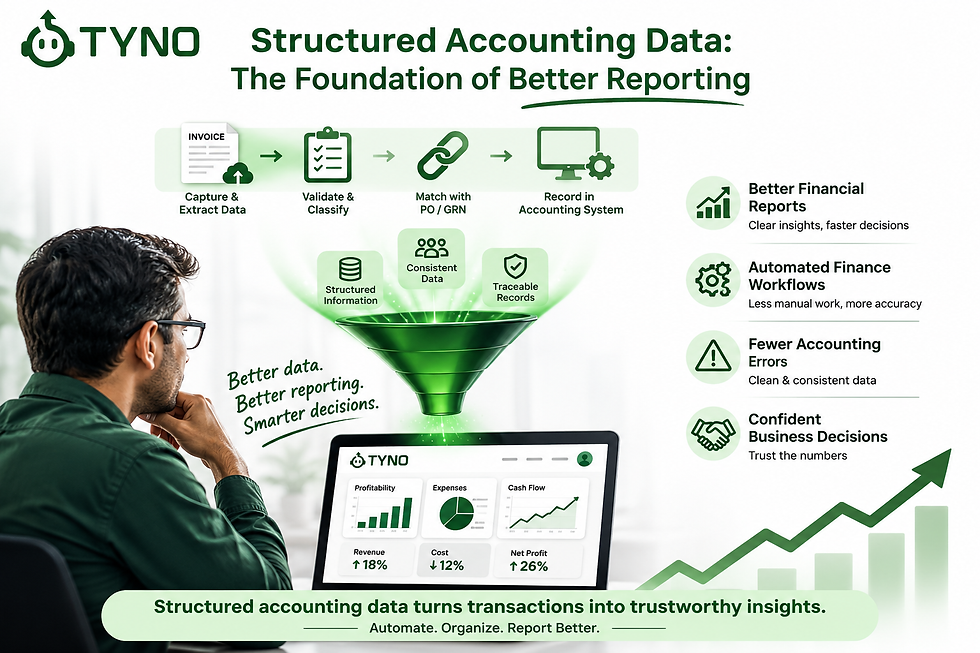
For example, an automated invoice workflow can help standardize how information is:
Captured from documents
Validated
Classified
Matched with purchase orders or GRNs
Recorded in accounting software
Stored with supporting documents
Used for downstream reporting
Instead of simply replacing manual typing, automation can create a repeatable process for generating accounting data. That distinction matters.
Automation of a bad process can make errors happen faster.Automation of a structured process can make finance more reliable.
Cleaner Accounting Means Less Time Spent Fixing Numbers
Finance teams often spend significant time answering questions such as:
"Why doesn't this number match?"
"Which invoice is this payment for?"
"Why is this expense showing under the wrong category?"
"Was this invoice actually recorded?"
"Where is the supporting document?"
These are not reporting problems. They are usually data and workflow problems appearing at the reporting stage. When accounting data is structured and traceable, these questions become easier to answer.
The finance team can spend less time searching, correcting, and reconciling—and more time analyzing what the numbers actually mean.
What Business Owners Should Look For?
You don't necessarily need another dashboard. Before investing in another reporting tool, look at the foundation underneath it.
Ask:
1. Is financial data captured consistently?
Are invoices, expenses, payments, and other transactions being recorded using standardized rules?
2. Can every number be traced back to its source?
If a report shows ₹10 lakh of purchases, can your team quickly identify the underlying transactions and supporting documents?
3. How much manual cleanup happens before reporting?
If someone has to spend several days correcting data before the monthly report can be trusted, the problem may be upstream.
4. Are accounting rules being applied consistently?
Different people should not be classifying similar transactions differently.
5. Can your finance process scale?
A process that works for 500 invoices may become a bottleneck at 5,000. Good finance infrastructure should become more efficient as transaction volumes grow—not require proportional increases in manual effort.
The Future of Business Reporting Is Not Just Better Dashboards
Dashboards are useful. Analytics are useful. AI-powered insights are useful. But none of them can compensate for poor accounting data.
The real foundation of better reporting is a finance process where information is:
Structured. Consistent. Traceable. Reliable.
Once that foundation exists, businesses can automate more workflows, reconcile faster, generate more meaningful reports, and make decisions with greater confidence.
And this is where modern finance automation is heading. The goal isn't simply to eliminate manual data entry.
The goal is to build a finance workflow that continuously produces reliable, structured accounting data.
Because when the underlying data is right, reporting becomes easier.
And when reporting becomes more reliable, business owners can spend less time questioning the numbers—and more time acting on them.
Better Accounting Starts Before the Report
At Tyno AI, we believe better financial reporting starts with better accounting processes.
Tyno helps businesses automate finance workflows around invoices, accounting data, reconciliation, and reporting—while keeping the underlying information structured and connected to the accounting system.
Because better reporting doesn't begin with a dashboard. It begins with better data.


Comments