
Why Reporting Problems Usually Start in Accounts Payable
- vikas hiran
- Jul 24
- 3 min read

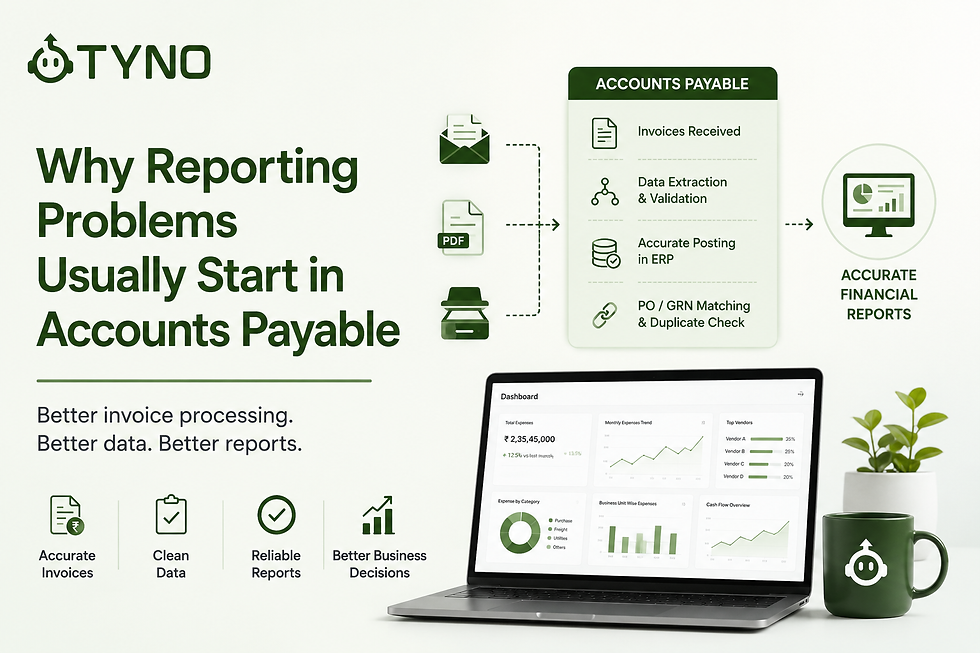
Finance leaders often assume reporting problems are caused by Excel, ERPs, or BI tools.
"We need a better dashboard." "We need Power BI." "We need another reporting module."
But in many businesses, the real problem starts much earlier.
It starts in Accounts Payable (AP). If invoices are entered late, entered incorrectly, or processed manually, every financial report generated afterward becomes less reliable.
Better reports don't begin with better dashboards. They begin with better accounting data.
Reporting Is Only as Good as the Data Behind It
Imagine trying to build a monthly P&L. Some invoices are still lying in email. Some are waiting for approval. Some are entered with the wrong expense ledger. A few are duplicated. Others haven't been entered at all.
Even if your ERP produces a report instantly, the numbers won't reflect reality. The reporting system is doing exactly what it was asked to do. It's simply reporting inaccurate or incomplete accounting data.
Small AP Errors Become Large Reporting Problems
Many reporting issues originate from small manual mistakes during invoice processing.
Examples include:
Wrong expense ledger selection
Incorrect GST classification
Duplicate invoice entry
Missing invoices
Wrong vendor mapping
Incorrect business unit allocation
Delayed invoice posting
Manual data entry mistakes
Each mistake may appear insignificant.
Across hundreds or thousands of invoices every month, these errors compound into unreliable financial reports.
Why Finance Teams Lose Confidence in Reports
When management notices inconsistent numbers, finance teams often spend days verifying data instead of analyzing it.
Questions start appearing:
Why did expenses increase?
Why doesn't this match last month's report?
Why is vendor spending different?
Why is the cash flow report changing every week?
Instead of making decisions, everyone starts investigating the data. Reporting becomes an audit exercise.
Month-End Becomes a Firefighting Exercise
Many finance teams experience the same pattern every month. Week one feels manageable. Then month-end arrives.
Now the team must:
Collect missing invoices
Download attachments from emails
Enter invoice data manually
Verify GST details
Match invoices with purchase orders
Reconcile vendor balances
Correct accounting mistakes
Generate management reports
The reporting delay is often caused by the workload created during invoice processing.
Not by reporting software.
Better Reporting Starts with Better Invoice Processing
When invoice processing is standardized and automated, reporting improves naturally.
Invoices are captured faster. Vendor information stays consistent. Accounting entries become standardized. Duplicate invoices are identified early. Purchase order references remain linked. Business unit allocation becomes consistent.
As a result:
Month-end closes faster
Reports become more accurate
Finance teams spend less time correcting data
Leadership gains confidence in financial numbers
Automation Improves Reporting Without Changing Your ERP
Many organizations assume they need a new ERP to improve reporting. Often they don't. If the ERP already stores financial data, improving the quality of data entering the system delivers significant reporting improvements.
AI-powered invoice processing can:
Extract invoice data automatically
Suggest ledger accounts
Validate GST information
Detect duplicate invoices
Match invoices with purchase orders or GRNs
Apply predefined accounting rules before posting
Reduce manual data entry significantly
The ERP continues doing what it already does well. The difference is that it receives cleaner, more accurate accounting data.
A Real Example
One of our customer, Growing EV charging company was processing over 2,000 invoices every month and 5000+ bank transactions per month.
The finance team spent considerable time manually entering invoice details, validating data, and matching invoices with purchase orders before posting them into Tally.
Management reports were frequently delayed because invoice processing wasn't completed on time.
After automating invoice processing with Tyno:
Invoice data entry became largely automated.
PO references were matched automatically.
Duplicate invoices were identified early.
Reports became available much sooner after month-end.
The biggest improvement wasn't simply faster invoice processing. It was having reliable financial data available when management needed it.
Reporting Is an Output, Not the Starting Point
Organizations often invest in dashboards before fixing the accounting process that feeds those dashboards.
But every report depends on:
Accurate invoice capture
Correct accounting entries
Consistent ledger mapping
Timely processing
Clean financial data
If these foundations are weak, no reporting tool can fully compensate. Improving Accounts Payable is often the fastest way to improve reporting quality across the entire finance function.
Final Thoughts
Finance reporting doesn't usually fail because reports are poorly designed. It fails because the underlying accounting data is incomplete, delayed, or inconsistent.
The good news is that this problem is fixable. By improving how invoices are captured, validated, and recorded, finance teams can reduce month-end stress, improve reporting accuracy, and spend more time analyzing the business instead of correcting data.
At Tyno, we've seen that organizations don't necessarily need a new ERP to achieve better reporting.
In many cases, they simply need cleaner financial data entering the ERP through automated invoice processing, intelligent validation, and standardized accounting workflows.
Reliable reports begin long before someone clicks "Generate Report." They begin the moment an invoice enters Accounts Payable.


Comments